
Some links in this article may be affiliate links. We may earn a commission at no extra cost to you.
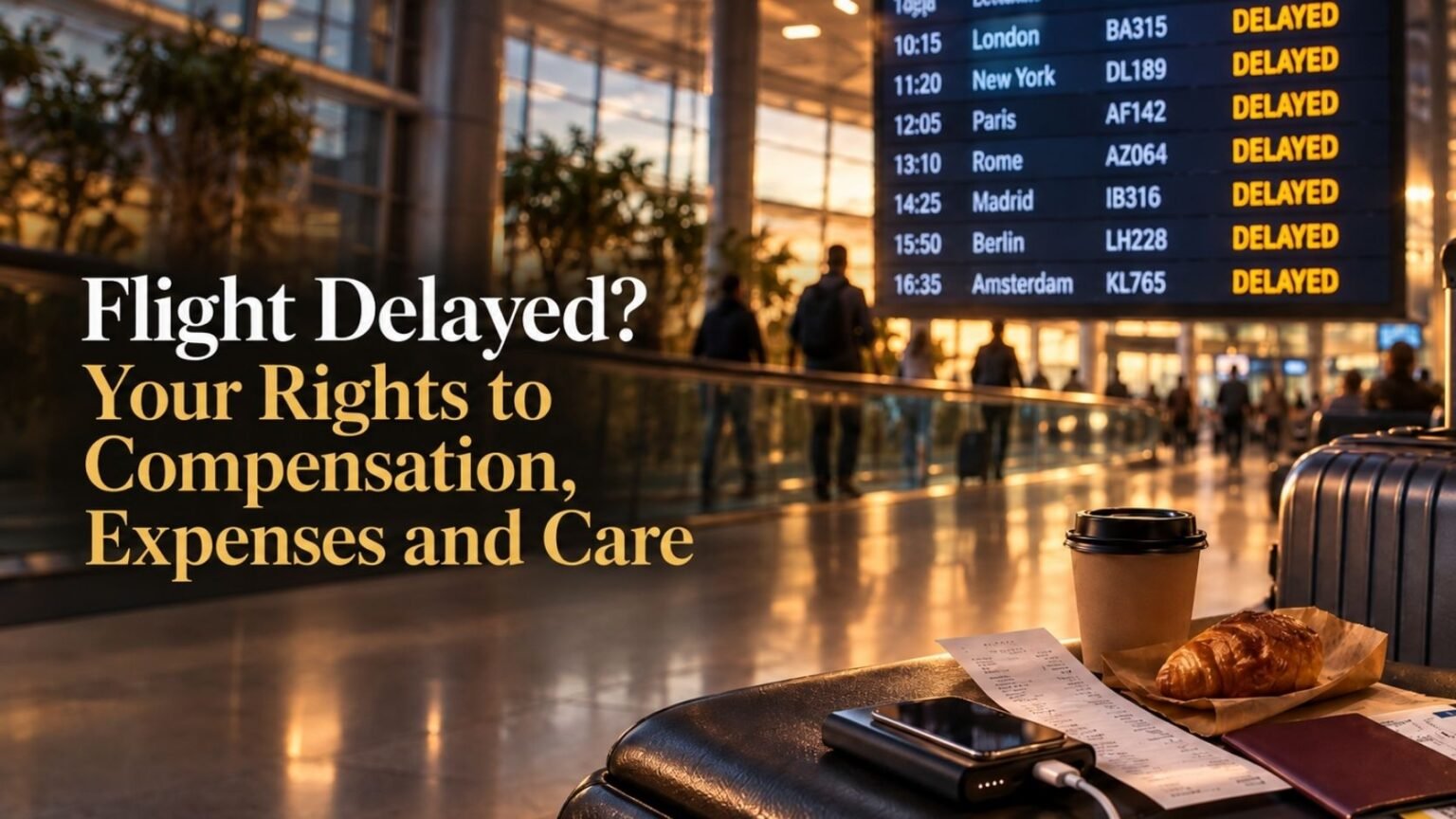
Flight Delayed? Your Rights to Compensation, Expenses and Care
A flight delay can cost you much more than time.
You can suddenly find yourself paying for airport food, drinks, transport or even a hotel because your flight is not leaving when it should.
And if the delay is long enough, you may also be entitled to flight compensation.
The important thing is understanding that compensation, expenses and the airline’s duty of care are different rights.
You might be entitled to compensation and reimbursement of expenses.
Or you might receive no compensation at all but still have a right to food, accommodation, transport and other reasonable care while you wait.
Knowing the difference can help make sure you do not end up paying costs that the airline should have covered.
Does UK261 or EU261 apply to your flight?
Before working out how much compensation you might be entitled to, you first need to know which passenger-rights rules cover your journey.
For UK travellers, UK261 is particularly important.
UK passenger-rights legislation generally covers:
- flights departing from the UK, regardless of which airline operates them
- flights arriving in the UK where the operating airline is a UK or EU carrier
Flights arriving in the UK from outside Europe on a non-UK/non-EU airline may fall outside UK261, although another country’s passenger-rights rules may apply. Civil Aviation Authority
EU261 generally covers flights departing from an EU airport regardless of the airline, as well as qualifying flights arriving in the EU from outside the EU when operated by an EU airline.
That means the route and the airline operating your flight can both matter.
If you are unsure which passenger-rights rules apply to your journey, see International Travel Rights: Know Your Rights When Flying Abroad.
When can a flight delay qualify for compensation?
If your flight is covered by UK261 or EU261, a long delay at your final destination can potentially entitle you to fixed compensation.
The important time is generally how late you arrive, rather than simply how late the aircraft departed.
A delay of around three hours or more at your final destination can potentially qualify, provided the other conditions are met.
But the length of the delay is only one part of the test.
The reason for the delay matters too.
If the disruption was caused by genuine extraordinary circumstances outside the airline’s control, fixed compensation may not be payable.
How much flight-delay compensation can you receive under UK261?
For flights protected by UK passenger-rights legislation, the compensation amount depends on the distance of the flight and, for long-haul journeys, how late you eventually arrive.
Current UK261 compensation levels are:
- Flights under 1,500km: £220 per passenger
- Flights between 1,500km and 3,500km: £350 per passenger
- Flights over 3,500km arriving between three and four hours late: £260 per passenger
- Flights over 3,500km arriving more than four hours late: £520 per passenger
These are fixed compensation amounts and are not based on how much you paid for your ticket. Civil Aviation Authority
So a passenger who paid £60 for a flight could potentially receive more in statutory compensation than the original ticket cost if the claim qualifies.
Compensation is also calculated per eligible passenger, not per booking.
How much flight-delay compensation can you receive under EU261?
For qualifying EU261-covered flights, compensation can generally be:
- €250 for flights of 1,500km or less
- €400 for longer intra-EU flights and other qualifying flights between 1,500km and 3,500km
- up to €600 for qualifying flights over 3,500km
The amount depends on the flight distance and circumstances of the delay.
Again, this is fixed statutory compensation rather than reimbursement of what you paid for the ticket.
My Morocco delay: €400 each
One of the first times I claimed flight compensation was after a return flight from Morocco with my mum.
Our flight arrived more than three hours late and we each received €400 compensation.
That was €800 between us.
Considering our entire four-day trip had cost less than £500, the compensation was actually worth more than the holiday itself.
But more importantly, it showed me why knowing your passenger rights matters.
It would have been very easy to think:
“The flight was delayed. These things happen.”
And sometimes they do.
But where passenger-rights legislation says compensation is due, there is no reason to leave that money unclaimed.
Compensation is not the same as expenses
This distinction is one of the most important things to understand.
Flight compensation is a fixed payment that may be available when a qualifying delay meets the relevant passenger-rights rules.
Expenses reimburse reasonable money you had to spend because the airline failed to provide care it was required to provide.
That means you might potentially receive both.
For example, you could qualify for fixed compensation because you arrived more than three hours late and separately claim back a reasonable hotel, food or transport bill.
Equally, you might qualify for £0 compensation but still be entitled to reasonable expenses.
Keep the two claims separate.
When does the airline have to look after you?
Your right to care can begin before you reach the three-hour compensation threshold.
For flights covered by UK261, the airline’s duty of care generally begins after:
- 2 hours for flights under 1,500km
- 3 hours for flights between 1,500km and 3,500km
- 4 hours for flights over 3,500km
Once you reach the relevant threshold, the airline should provide reasonable food and drink, communication and, where an overnight stay becomes necessary, accommodation and transport between the airport and that accommodation. Civil Aviation Authority
So do not assume you always have to wait three hours before the airline owes you any assistance.
For shorter flights, your right to care can begin after only two hours.
What should the airline provide during a long delay?
Where the duty of care applies, the airline may provide assistance directly.
That can include:
- meal or refreshment vouchers
- hotel accommodation
- transport between the airport and hotel
- communication
- instructions to arrange accommodation through its app or website
Where the airline provides suitable assistance directly, use that where reasonable.
But during large-scale disruption, airlines do not always manage to provide everything passengers need.
If the airline fails to provide the care you are entitled to, you may be able to make your own reasonable arrangements and claim the cost back afterwards.
What expenses can you claim back?
Depending on the circumstances, reasonable expenses can include the following.
Food and refreshments
If you are stuck at the airport beyond the applicable threshold, reasonable meals and drinks may be covered.
That does not mean unlimited spending.
Buy what you genuinely need while waiting.
Hotel accommodation
If the delay unexpectedly leaves you stranded overnight, reasonable accommodation may be covered.
Transport between the airport and your accommodation
This may include appropriate public transport, a hotel shuttle or a reasonable taxi where necessary.
Travelling home and back to the airport
If you live reasonably close to the airport, there can be circumstances where travelling home and returning to the airport is more appropriate than staying in a hotel.
Communication
The UK261 duty of care also provides for communication assistance, including phone calls or emails.
Keep every itemised receipt
This is one of the most important practical things you can do during a delay.
Keep the receipt.
Not just the bank transaction.
Not just a screenshot showing that £90 left your bank account.
Where possible, keep an itemised receipt or invoice showing exactly what you purchased and how much it cost.
If you buy dinner, breakfast, accommodation or airport transport, keep the evidence.
Photograph paper receipts as a backup if necessary.
A small paper receipt can be very easy to lose after a stressful journey.
What counts as a reasonable expense?
There is no single amount that every passenger can automatically spend.
The important question is whether the expense was necessary and reasonable in the circumstances.
If you are stranded overnight during major disruption and the only reasonably available hotel near the airport is expensive, that does not automatically make the cost unreasonable.
But passengers are still expected to act sensibly.
Luxury hotels, luxury meals and alcoholic drinks may not be reimbursed.
So do not treat disruption as an opportunity for an expensive night out at the airline’s expense.
Choose what you genuinely need and be prepared to explain why the expense was necessary.
Ask the airline for help before paying yourself
Where practical, ask the airline what assistance it is providing before making your own arrangements.
You might ask:
“Are you providing meal vouchers?”
“Are you arranging accommodation?”
“How am I getting to the hotel?”
If the airline says it cannot provide anything, make a note of that.
If you cannot reach anyone because of long queues, unanswered chats or a closed service desk, keep evidence of your attempts to get help.
That can become useful later if the airline asks why you arranged something yourself.
Don’t reject reasonable care and then choose something much more expensive
Suppose the airline offers you a reasonable hotel and transport.
You decide you do not like the hotel and book a much more expensive one yourself.
You should not automatically expect the airline to pay the difference.
Where reasonable care has already been offered and a passenger rejects it in favour of a more expensive alternative, reimbursement of the additional expense may become more difficult.
So if the assistance offered is genuinely reasonable, think carefully before refusing it.
What if your flight is delayed overnight?
If the delay continues into the following day and you need to stay overnight, the airline’s duty of care can include:
- hotel accommodation
- transport from the airport to the hotel
- transport back to the airport
If the airline does not arrange accommodation, ask what it wants you to do.
If you are told to book a hotel yourself, try to get that instruction in writing.
If you cannot get assistance at all, choose a reasonable option and keep the hotel invoice, booking confirmation, transport receipts and any messages or screenshots showing what happened.
What if the delay was caused by bad weather?
This is where compensation and care need to be separated.
Bad weather, air traffic control problems and other genuine extraordinary circumstances can mean that fixed flight compensation is not payable.
But that does not automatically remove the airline’s duty of care.
Where UK261 applies, the airline can still have to provide qualifying passengers with food, drink, accommodation and other care regardless of what caused the delay. Civil Aviation Authority
So you could receive:
£0 in flight compensation
but still be entitled to reasonable:
- meals
- refreshments
- accommodation
- transport
if the delay is long enough.
Do not throw away your receipts simply because the airline says the disruption was outside its control.
For more detail on when airlines can avoid fixed compensation, see Extraordinary Circumstances: When Airlines Don’t Have to Pay Compensation.
Take photos and screenshots while you are delayed
Receipts show what you spent.
Other evidence can help show why you had to spend it.
Where useful, take photographs or screenshots of:
- departure boards
- changing departure times
- airline app notifications
- text messages
- delay emails
- closed service desks
- relevant queues
- conversations with airline customer service
- instructions telling passengers to arrange their own accommodation or transport
You do not need hundreds of photographs.
Collect the evidence that genuinely helps establish what happened and why you had to make your own arrangements.
What if you need toiletries or clothes?
For an ordinary flight delay, the clearest duty-of-care rights cover things such as food, refreshments, communication, accommodation and transport associated with accommodation.
So be cautious about assuming every incidental purchase will automatically be reimbursed.
If you incur another genuinely necessary expense because of unusual circumstances, keep the receipt and explain why you needed it when making the claim.
But do not assume that every purchase automatically falls under UK261 or EU261.
And remember that costs caused by delayed baggage are governed by different rules.
See Lost, Delayed or Damaged Luggage: Your Rights for that situation.
What if your flight is delayed by five hours?
A five-hour delay can give you an additional choice.
If your flight is delayed by at least five hours, UK passenger-rights rules allow you to choose not to travel and obtain a refund for the unused flights on your booking. Civil Aviation Authority
If you are already part-way through a connecting journey and decide to abandon the trip, there can also be circumstances where the airline has to arrange transport back to your original departure point.
But do not choose reimbursement if you still intend to take the delayed flight.
Once you decide not to travel and accept a refund, your position changes.
What about connecting flights?
Connecting journeys require a little more care.
If your flights are on the same connecting booking and a delay to the first flight causes you to miss the next one, your right to care can continue while you wait for the replacement connection.
That can include overnight accommodation where the next available connection does not leave until the following day.
But self-transfer journeys are different.
If you independently buy separate tickets and the first flight is delayed, causing you to miss an unrelated second booking, you do not automatically have the same statutory rights all the way to the final destination.
The rights relating to each individual flight may need to be considered separately.
For compensation specifically relating to missed connections, see Missed Connection Compensation: When Can You Claim?
How do you claim flight-delay expenses?
Start with the airline.
Most airlines provide an online claim or reimbursement form.
You will normally want to provide:
- your booking reference
- flight number
- date of travel
- details of the delay
- a short explanation of what happened
- an itemised breakdown of the expenses
- receipts or invoices
- any supporting evidence
Keep a copy of everything you submit.
A simple breakdown makes the claim easier to understand.
For example:
Dinner: £16.80
Hotel: £89.00
Taxi to hotel: £18.50
Taxi back to airport: £17.00
Total reimbursement requested: £141.30
Make it obvious what each expense relates to.
How do you claim flight-delay compensation?
Compensation should also normally be claimed directly from the airline first.
Keep the claim for fixed compensation clearly separate from reimbursement of your expenses.
The airline may even have different forms for the two.
Your compensation claim concerns whether the delay satisfies the passenger-rights requirements.
Your expenses claim concerns the reasonable costs you incurred because the airline did not provide the required care.
Compensation is not paid automatically, so you generally need to submit a claim to the airline. Civil Aviation Authority
Do not combine everything into one unexplained total.
What if the airline rejects or ignores your claim?
First, read the reason carefully if the airline has provided one.
For an expenses claim, the airline might argue that:
- the expense was excessive
- suitable care had already been offered
- evidence or receipts are missing
- the expense was not covered
- your delay did not reach the relevant duty-of-care threshold
For a compensation claim, the dispute may instead relate to the length of the delay, whether the flight falls within the rules or whether extraordinary circumstances caused the disruption.
If you believe the rejection is wrong, respond with the evidence supporting your position.
Keep the airline’s final response.
If the airline does not respond, you do not necessarily have to keep chasing indefinitely. Under the current UK complaints process, unresolved claims may be escalated after the relevant complaint period to the airline’s ADR provider or, where applicable, the CAA’s Passenger Advice and Complaints Team. Civil Aviation Authority
For the full escalation process, see Flight Compensation Claim Rejected or Ignored? What to Do Next.
The bottom line
If your flight is seriously delayed, do not think only about whether you are entitled to compensation.
Ask two separate questions:
“Am I entitled to flight-delay compensation?”
and
“What does the airline have to provide for me while I wait?”
Those questions can produce completely different answers.
You may qualify for fixed compensation because you reached your final destination more than three hours late.
For a qualifying UK261 claim, that could currently mean £220, £350, £260 or £520 per passenger, depending on the flight distance and, for long-haul flights, the length of the arrival delay. Civil Aviation Authority
You may also have rights to meals, refreshments, accommodation and transport.
Or you may receive no compensation because extraordinary circumstances caused the delay but still have a right to reasonable care and reimbursement of necessary expenses.
So remember:
Ask the airline for assistance first where possible.
Keep every itemised receipt.
Spend reasonably.
Take screenshots or photographs where they help prove what happened.
Keep compensation and expenses separate.
And do not assume that an airline saying “the delay wasn’t our fault” automatically means “we owe you nothing.”
That distinction can be worth a significant amount of money when your journey goes wrong.

Ready to plan your next trip?
Turn inspiration into a holiday you can actually book.
Handpicked DealsDiscover great holiday deals worth exploring.
Travel PlanningTips, guides and ideas to inspire your next trip.
Trusted ProvidersBook directly with established travel brands.