
Some links in this article may be affiliate links. We may earn a commission at no extra cost to you.
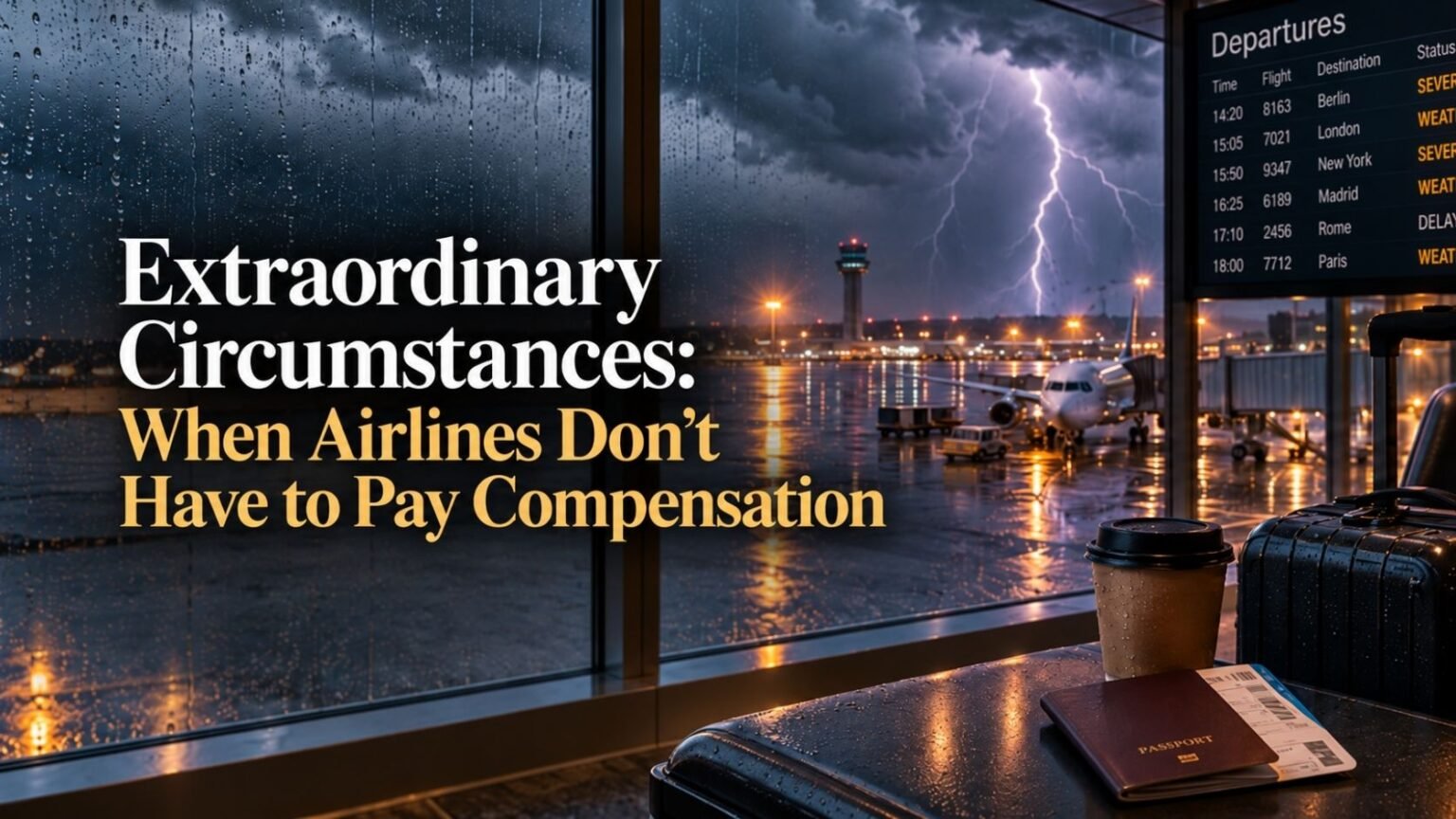
Extraordinary Circumstances: When Airlines Don’t Have to Pay Compensation
If your flight is delayed or cancelled, one of the most common reasons an airline may refuse to pay compensation is:
“The disruption was caused by extraordinary circumstances.”
That phrase matters because, under UK261 and EU261, airlines do not normally have to pay fixed compensation where the disruption was caused by extraordinary circumstances and the delay or cancellation could not have been avoided even if all reasonable measures had been taken.
But extraordinary circumstances does not simply mean “something unexpected happened.”
Not every technical problem, staffing issue or operational difficulty automatically allows an airline to avoid paying compensation.
And even where extraordinary circumstances genuinely apply, you can still have important rights to care, rerouting or a refund. Pasted markdown
Last updated: October 2026. This guide provides general information about passenger rights and is not legal advice.
What are extraordinary circumstances?
In simple terms, an airline cannot usually rely on extraordinary circumstances merely because an event was unusual or inconvenient.
The relevant circumstances generally need to be outside the airline’s normal activity and beyond its actual control.
There is also another important part of the test:
The airline must show that the disruption could not have been avoided even if all reasonable measures had been taken.
So there are really two important questions:
Was the event genuinely extraordinary?
and
Could the airline reasonably have avoided or reduced the resulting disruption?
The UK Civil Aviation Authority gives examples that may fall within extraordinary circumstances, including:
- weather conditions incompatible with safely operating the flight
- strikes involving people outside the airline, such as air traffic control or airport staff
- terrorism or sabotage
- security risks
- political or civil unrest
- certain air traffic control decisions
- hidden manufacturing defects affecting aircraft
- bird strikes
- foreign-object tyre damage
- runway fuel spills
- disruption caused by an unruly passenger
Every case still depends on its individual facts. Pasted markdown
So simply writing:
“Extraordinary circumstances.”
in a rejection email does not settle the issue.
Who has to prove extraordinary circumstances?
If an airline relies on extraordinary circumstances to refuse fixed compensation, the airline needs to justify that position.
It should be able to show:
- what extraordinary event occurred
- how that event caused your particular delay or cancellation
- why the event was outside its control
- what reasonable measures it took to avoid or reduce the disruption
- why the disruption could not reasonably have been prevented despite those measures
This matters because passengers will not normally have access to all the airline’s operational information.
You may know that your flight was cancelled.
You may not know what happened to the aircraft earlier in the day, what air traffic control restrictions applied or what operational decisions the airline made.
That is why a vague statement such as:
“Your flight was affected by extraordinary circumstances.”
should not necessarily be treated as a complete explanation.
Ask the airline to explain what actually happened and why it believes the legal exemption applies.
Bad weather can count
Severe weather is probably one of the easiest examples to understand.
If weather conditions make it unsafe to operate the flight, the airline cannot reasonably be expected to fly simply to avoid paying compensation.
Weather incompatible with safe flight operations can therefore qualify as an extraordinary circumstance. Pasted markdown
But the circumstances still matter.
The airline should be able to explain how the weather actually affected your flight rather than simply saying:
“There was bad weather somewhere.”
The relevant problem could involve:
- dangerous winds
- heavy snow
- thunderstorms
- visibility problems
- airport closures or restrictions caused by weather
It is the connection between the conditions and your flight disruption that matters.
Air traffic control problems can count too
Air traffic control restrictions, decisions or system failures can fall outside an airline’s control.
This became particularly relevant in September 2026 when the UK Civil Aviation Authority said disruption caused by technical problems at National Air Traffic Services was likely to amount to extraordinary circumstances.
The CAA nevertheless reminded airlines that they still had responsibilities towards passengers whose flights were delayed or cancelled. Pasted markdown
This is a good example of the distinction between:
compensation
and
the airline’s duty to look after you.
You may not receive fixed compensation for qualifying air traffic control disruption.
But that does not automatically mean the airline can leave you stranded without assistance.
What about strikes?
This can become more complicated because not every strike is treated in the same way.
A strike involving organisations or workers outside the airline, such as:
- airport staff
- air traffic controllers
- some ground-handling operations
- border-force staff
may amount to an extraordinary circumstance, depending on the facts. Pasted markdown
But industrial action involving the airline’s own employees is not automatically extraordinary simply because it disrupts flights.
Internal airline staff strikes are generally treated differently because managing relations with the airline’s own workforce forms part of operating the business.
So if an airline rejects your compensation claim because of a:
“strike”
find out:
Who was actually on strike?
The answer can make a significant difference.
Are technical problems extraordinary circumstances?
Usually, no.
This is one of the most important things travellers should understand.
An aircraft developing a technical fault does not automatically allow the airline to avoid compensation.
Ordinary technical problems, component failures and issues associated with normal aircraft maintenance are generally part of operating an airline and are not normally considered extraordinary circumstances. Pasted markdown
This applies even though a technical failure may have been unexpected.
Unexpected does not automatically mean extraordinary.
Aircraft require maintenance, components fail and airlines are expected to deal with ordinary technical problems as part of their normal operations.
When can a technical problem be extraordinary?
There are exceptions.
A technical problem can potentially qualify where it arises from something genuinely outside the airline’s normal activity and control.
One example is a hidden manufacturing defect identified by an aircraft manufacturer that results in aircraft being grounded.
Sabotage or terrorism affecting an aircraft may also potentially amount to extraordinary circumstances. Pasted markdown
So if your claim is rejected with nothing more than:
“Aircraft technical issue.”
do not automatically assume that is sufficient.
Ask:
What was the technical issue?
Why does the airline consider it extraordinary rather than an ordinary operational or maintenance problem?
What about airline staff shortages?
Ordinary problems managing an airline’s own crew and staffing levels are not automatically extraordinary circumstances.
Recruiting enough staff, preparing crew rosters, managing sickness levels and maintaining sufficient operational resources are ordinarily part of running an airline.
So an airline should not be able to avoid compensation simply because it unexpectedly found itself short of its own crew or operational staff.
That does not mean every staffing-related disruption is automatically the airline’s responsibility.
For example, an apparent crew shortage could sometimes be the direct consequence of an earlier extraordinary event, such as major air traffic control disruption that leaves aircraft and crews out of position.
In that situation, the airline may argue that the staffing problem was a knock-on consequence of the original extraordinary circumstance.
The important point is that:
“Crew unavailable”
or
“staff shortage”
is not, by itself, enough to establish extraordinary circumstances.
The airline should still explain what caused the staffing problem and how it relates to your particular flight. Pasted markdown
What about knock-on delays?
This can become complicated.
Sometimes an extraordinary event affects one flight and then causes disruption to later flights using the same aircraft or crew.
So the fact that conditions looked completely normal at your airport does not automatically mean an earlier extraordinary event is irrelevant.
For example, the CAA said some knock-on disruption following the September 2026 NATS technical problem was also likely to qualify as extraordinary where it was directly caused by that event. Pasted markdown
But the airline still needs to establish the connection.
A vague explanation such as:
“Knock-on operational disruption.”
should not necessarily end the matter.
Ask:
- What original event caused the disruption?
- Which earlier flight or operation was affected?
- How did that event affect your aircraft or crew?
- What did the airline do to minimise the knock-on delay?
The further removed your flight is from the original event, the more important it can become for the airline to demonstrate the actual causal connection.
The airline must take reasonable measures
Even where there genuinely was an extraordinary circumstance, the airline is not automatically exempt from compensation merely because the event occurred.
It must also show that the delay or cancellation could not have been avoided even if all reasonable measures had been taken. Pasted markdown
That means looking at how the airline responded.
Depending on the circumstances, relevant questions might include:
Did the airline try to minimise the delay?
Did it make reasonable operational adjustments?
Could another available aircraft or crew reasonably have been used?
Could the impact on passengers reasonably have been reduced?
This does not mean an airline is required to take every imaginable step regardless of cost or practicality.
What counts as reasonable will depend on the circumstances.
But the important point is:
Extraordinary event + no reasonable way of avoiding the resulting disruption
is very different from simply:
Extraordinary event happened.
What if the airline gives you a vague explanation?
If your compensation claim is rejected and the airline simply says:
“Extraordinary circumstances applied.”
ask for more information.
Useful questions include:
- What exactly caused the disruption?
- When did the problem occur?
- How did it affect my flight?
- Why is the airline treating it as an extraordinary circumstance?
- What reasonable measures were taken to prevent or reduce the delay or cancellation?
The airline should be able to explain why it believes the extraordinary-circumstances exemption applies. Pasted markdown
Keep its response.
If you later challenge the rejection through ADR, a regulator or court proceedings, the airline’s explanation can become important evidence.
No compensation does not mean no rights
This is probably the most important part of this guide.
If extraordinary circumstances genuinely apply, you may not receive the fixed compensation normally available under UK261 or EU261.
But that does not remove the airline’s other responsibilities.
Depending on what has happened, you may still have rights to:
- rerouting
- a refund where applicable
- reasonable food and refreshments while waiting
- hotel accommodation where an overnight stay becomes necessary
- transport between the airport and accommodation
- reimbursement of reasonable expenses where the airline fails to provide the care it should
So an airline cannot necessarily say:
“It wasn’t our fault, therefore we owe you nothing.”
That is not how these rights work. Pasted markdown
If your flight has been delayed, see:
Flight Delayed? Your Rights to Compensation, Expenses and Care
If your flight has been cancelled, see:
Flight Cancelled? Your Rights to a Refund, Rerouting and Expenses
Those guides explain the separate rights that can continue even where fixed compensation is unavailable.
Keep your receipts even if the disruption was outside the airline’s control
If you are stuck waiting for hours or overnight, keep every itemised receipt for reasonable expenses.
Even where you ultimately receive £0 in fixed compensation, the airline may still have a duty to provide appropriate care.
If it fails to do so and you reasonably have to pay yourself, you may still be able to recover costs such as:
- reasonable meals
- refreshments
- necessary accommodation
- reasonable transport between the airport and your hotel
Keep your spending sensible and retain evidence.
A compensation claim and an expenses claim are two separate things. Pasted markdown
What if your flight is cancelled?
If a qualifying flight is cancelled because of genuine extraordinary circumstances, you may not receive fixed cancellation compensation.
But you should still generally be offered the relevant choice between:
a refund
or
rerouting.
If you choose rerouting and have to wait, the airline can also continue to have a duty to care for you.
For the full explanation, see:
Flight Cancelled? Your Rights to a Refund, Rerouting and Expenses. Pasted markdown
Take evidence while the disruption is happening
If something unusual is happening at the airport, keep useful evidence where appropriate.
That might include photographs or screenshots of:
- departure boards
- airline app notifications
- cancellation or delay messages
- relevant weather notices
- airline communications
- alternative flights
- closed customer-service desks or significant queues where relevant
Also keep:
- your boarding pass
- booking confirmation
- emails
- text messages
- any written information given to you by the airline
You do not need to photograph everything around you.
The purpose is simply to preserve useful evidence in case there is later a disagreement about what caused the disruption or how the airline responded. Pasted markdown
What if you don’t believe the airline?
Start by asking the airline to explain its position properly.
If you still believe the claim has been rejected incorrectly, keep its final response.
You can then check the appropriate independent escalation route.
Depending on the airline and journey, that could involve:
- an approved Alternative Dispute Resolution provider
- the CAA’s Passenger Advice and Complaints Team where appropriate
- another national enforcement or complaint body
Different airlines and routes can use different complaint organisations, so do not assume that the same ADR provider or regulator handles every airline.
For the full escalation process, see:
Flight Compensation Claim Rejected or Ignored? What to Do Next.
What if ADR or another complaint body agrees with the airline?
An independent body agreeing with the airline does not automatically mean there is nothing else you can do.
Read the decision carefully.
If the ADR provider or regulator identifies a genuine weakness in your claim, take that seriously.
But if you still believe the airline’s position is wrong and you have evidence supporting your claim, legal action may remain available.
Court proceedings should generally come after you have made reasonable attempts to resolve the dispute, rather than being your first step.
For more information, see:
Taking an Airline to Small Claims Court: UK Guide. Pasted markdown
Extraordinary circumstances: quick examples
A useful way to remember the distinction is:
Likely to be extraordinary
- severe weather that makes flying unsafe
- external air traffic control disruption
- airport or border-force strikes
- terrorism or sabotage
- significant security risks
- political or civil unrest
- certain hidden aircraft manufacturing defects
- bird strikes
- certain external runway or airport incidents
Usually not extraordinary
- ordinary aircraft technical faults
- routine component failures
- normal maintenance problems
- failure to properly maintain an aircraft
- ordinary shortages of the airline’s own crew or staff
- internal airline staff strikes
But these are not absolute rules.
Every claim depends on what actually happened, what caused the disruption and what the airline reasonably did in response. Pasted markdown
The bottom line
The phrase “extraordinary circumstances” is important because it can mean an airline does not have to pay fixed flight compensation.
But the airline cannot necessarily rely on the phrase merely because something unexpected happened.
Ask two key questions:
Was the event genuinely outside the airline’s normal activity and control?
and
Could the resulting disruption have been avoided if the airline had taken all reasonable measures?
If your compensation claim is rejected:
Find out exactly what happened.
Ask the airline to explain why it believes extraordinary circumstances apply.
Ask how the event actually affected your flight.
Ask what reasonable measures it took to prevent or reduce the disruption.
And remember:
The airline needs to justify its reliance on extraordinary circumstances.
Most importantly:
No compensation does not mean no passenger rights.
Even where the disruption genuinely was extraordinary, you may still have rights to care, rerouting, a refund and reimbursement of reasonable expenses.
So if an airline tells you:
“It wasn’t our fault.”
your next question should be:
“What rights do I still have?”





Ready to plan your next trip?
Turn inspiration into a holiday you can actually book.
Handpicked DealsDiscover great holiday deals worth exploring.
Travel PlanningTips, guides and ideas to inspire your next trip.
Trusted ProvidersBook directly with established travel brands.